

Bloke Town - a street where each address is a sequential loci scene
The BLOKES list of 60 places is a way to memorise 60 items in sequence (more if you can visualise more thasn one item at each location). But, for real life exam revision, 60 is not enough. I also have 100 locations in a sequence (see the poems article); and the Town 100 system article is a way to have 100 or even 1000 places in a sequence.
This article is about an imaginary street where each address is a scene involving a coloured terrain, a single-colour-fill sky, a prop on the left, a prop on the right, and a main building in the centre. Encrypted within that are map information about where on a globe to find a particular city. The building in the centre of the image is typically a representation of a landmark from a city. So, for London, a London landmark is in the centre. That building's fill pattern is from the list of 100 fill patterns which you see in the Double Digit Acrostics article. So a 2 digit number is represented by the fill pattern of the building. Eg. A cloudy strawberry fill represents 00. I want one scene to exist per country of the world. So there would be over 200 of them. Country (or state) number 150 could have its landmark building colour filled with pattern 50 because that is the right 2 digits of "150". The number of the scene matters (as is explained later).
Each prop (such as a lamp post) represents a 2 digit number. The fill colour decides if a -1 occurs before the two digit number or if a -0 occurs there; or if a 0 occurs there or a +1: Red [Colour 9], Green [colour 3], Black, Orange [Colour 1], respectively.
I will list the 50 props by name in alphabetical order; then I will list them enumerated:


Herea re the smae props lsited with two digit number labels::

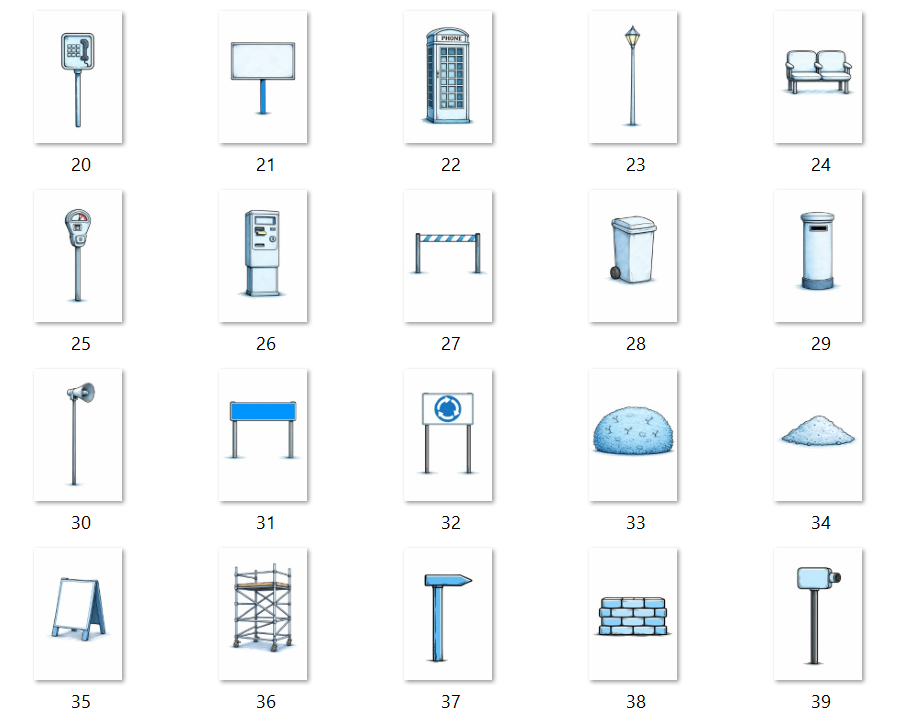

Adding 10 to the fill colour implies that the prop's normal number needs 50 added. So prop 20, with brown colour 11 rather than orange colour 1, requires 20+50 = 70 as the interpretation of the prop. And since orange colour 1 means 'prefix the 2 digit number with "1"', the 20 was really 120 and the brown is making the 20 become 50 more: 170.
The prop on the left of the scene is a longitude whole number; the prop on the right of the scene is a latitude whole number. The choice of prop and its colour can plot a particular position on an axis. Those co-ordinates are meant to plot a city like London's position on the world map. Countries occur in alphabetical order starting from place 1 and approaching around place 200 [around 200 countries or states]. If I am memorising text mentioning country 20 from that sequence then I can memorise an image of a world map followed by an image that means the number 20. Those two items mean "Country 20". Another icon can mean "Interpret 20 as capital city 20".
What would the terrain (the floor) mean?
I would like to make the types of ground indicate the general style of the state's flag:
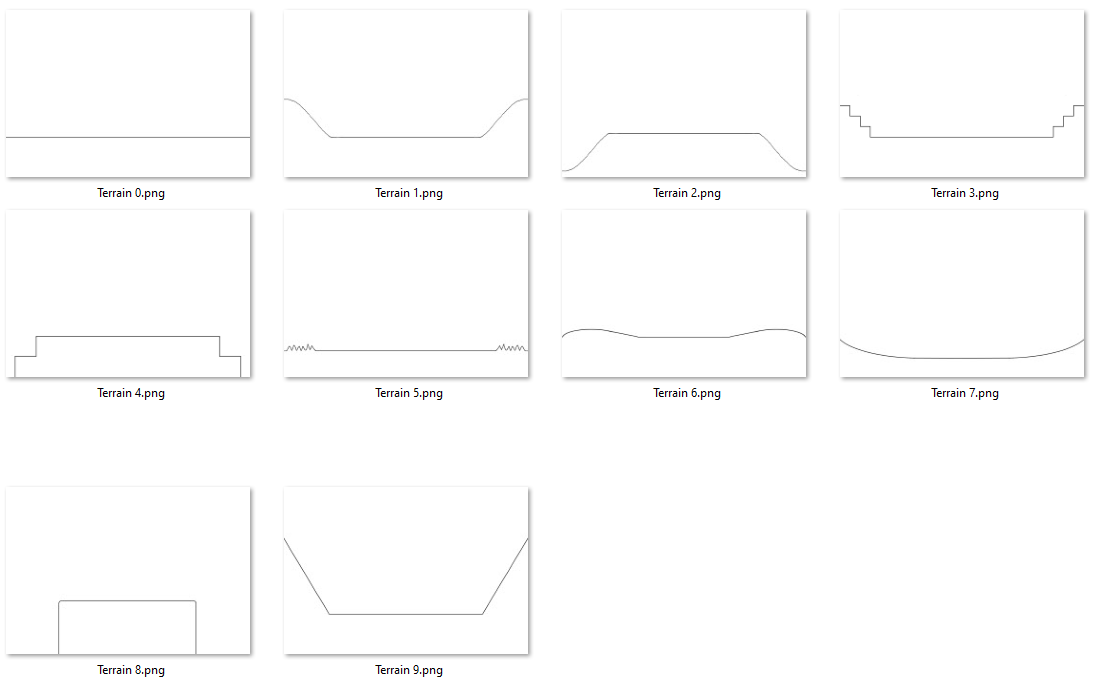
0. Not a good match for the flag styles listed below. [stats obtained from asking Gemini]:
1. Horizontal Tricolor / Triband (~33%): This is the most prevalent layout globally, appearing in roughly one-third of all national flags. It consists of three horizontal stripes, either with three unique colors (tricolor) or two alternating colors (triband).
2. Vertical Tricolor / Triband (~15%): Popularized by the French Revolution, this style features three vertical stripes. It is a staple design for many European and African nations.
3. The Canton (~12%): This style places a specific symbol or design in the top-left corner (the canton), which usually occupies a quarter of the total area. It is often used to denote a union or a historical lineage.
4. Horizontal Bicolor (~10%): A clean, two-toned design split horizontally. These are frequently used as the base for flags that later incorporate national crests or emblems.
5. Central Charge / Symbol (~8%): Rather than focusing on stripes or divisions, these flags feature a prominent central emblem on a solid or simple background, often representing a sun, star, or religious icon.
6. The Nordic Cross (~3%): A distinct cross where the vertical bar is shifted toward the hoist side. While geographically concentrated in Northern Europe, it remains one of the most recognizable structural styles in vexillology.
7. Vertical Bicolor (~3%): A simple vertical split into two equal fields of color. Though less common than the horizontal version, it provides a bold, high-contrast aesthetic.
8. The Saltire (~2%): This design utilizes a diagonal "X" shape extending from corner to corner. It is a classic heraldic layout that serves as the primary geometry for a small handful of sovereign states.
9. The Triangle / Chevron (~2%): This style features a triangle (or chevron) extending from the hoist side toward the center of the fly, often used to represent progress or a specific geographic feature.
The colour fill of the sky can represent a colour from the state's flag (see the Colours article).
The colour fill of the terrain can represent a colour from the state's flag (see the Colours article).
Other Country List
Since I made this Bloke Town of country places, I added eye detail to the Animals system (a system of 520 humanoid animals); and many of the animals now prompt a country name: the animal can be visualised as a representation of a particular country. So that makes the benefit of the Bloke Town lessen: animal people can be used instead.
I also wonder if longitude and latitude is as important as knowing more approximately where a city is on the globe. Another article about grids has a way of representing the globe as 36 squares across and 18 squares high; maybe the choice of 36 and the choice of 18 could be part of a mnemonic for where a city is; and if each square is itself expressed as 5 by 5 squares or some other slicing then that mini square might also be part of a mnemonic representation of where a city is located.
I am keen to keep this article here though because the municipal props could be handy for solving other mnemonics challenges.